
Narratoscope · Fiction
The Editors — Prologue
A possibly true story about three young people and a magic machine that rewrites the world with books. This is where it starts — or where I started letting you see it.
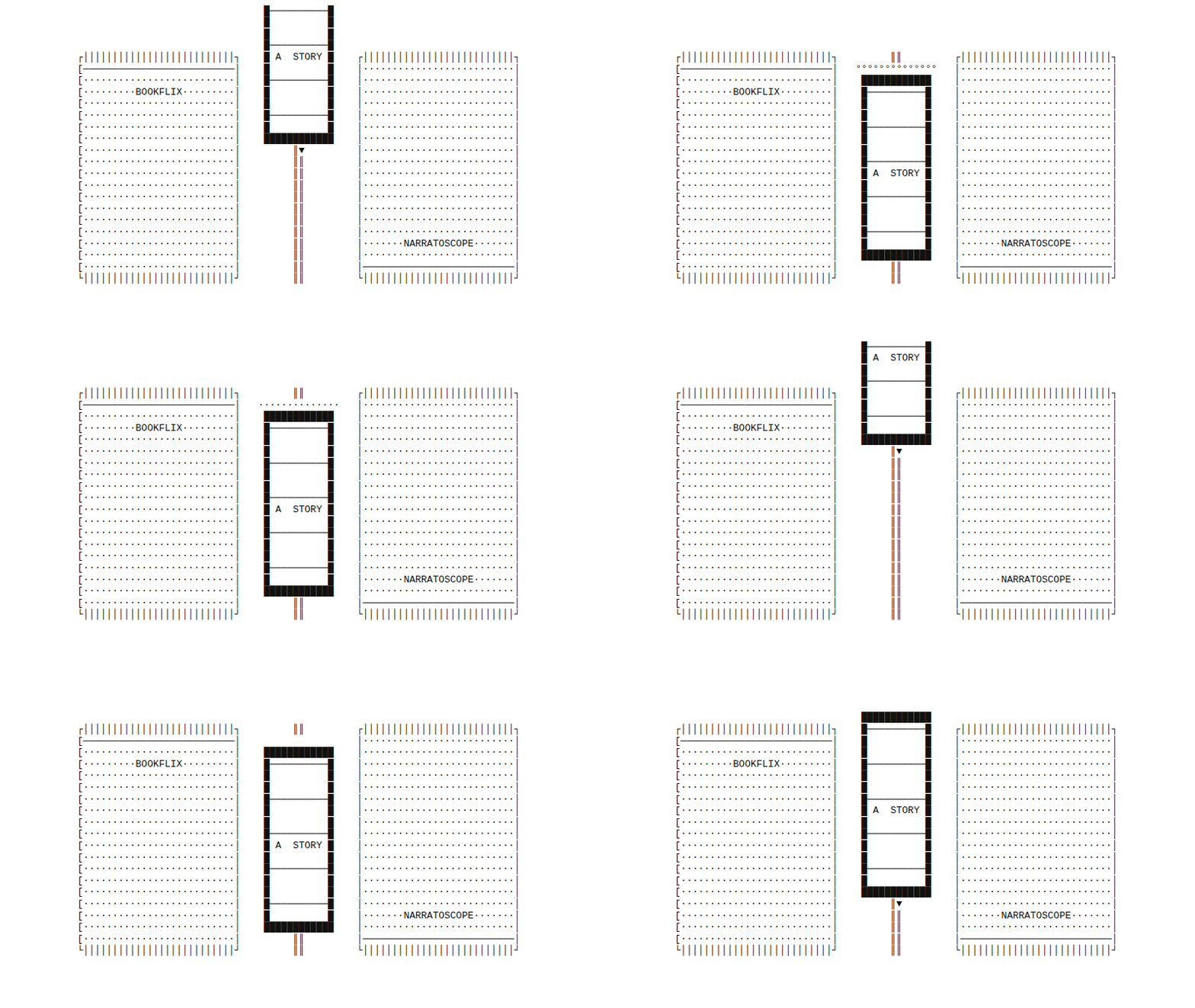
PROLOGUE
City K., Present Day
Bookshelves hum. Not loudly—you feel it more than hear it—that low vibration that comes off a wall of books late in the evening, when you sit down in front of them and just look, working out which one to pull down. Maybe you weren’t going to read anything that night at all. It didn’t matter. The hum was enough. Just sitting there for the sound of it: hundreds of stories folded into one low, even note. If you remember that feeling, you’ll understand the kind of vibration that came off the box.
The box said EDUCATIONAL SLIDE PROJECTOR. That was more than most of them said. But the vibration gave it away as something else.
Lida had been at it for three hours—she and the other two—working through the pallets the maintenance crew had hauled up from the basement archive. The lecture hall smelled of dust and old glue. The deal was simple: sort it, log it, mark each box KEEP or DISPOSE before the digitization team came on Monday. The pay, in keeping with the ancient university tradition, was nothing the department would ever put in writing: a favor, a vague good word, the kind of currency that buys a coffee if you save a year of it. Most of it was student theses from the eighties. Lida read the labels aloud; Misha typed them into the inventory file on a laptop that wheezed every time it slept; Nino, who was supposed to be photographing anything “of visual interest,” had instead filled three pages of her sketchbook and contributed nothing to the database.
“Petrova, Bagrationi, Reznik,” she said, apropos of nothing, balancing a box on her knee. “That’s our masthead. Sounds like a law firm. Or a rock band.” She squinted at the next spine. “Editor, illustrator, and—what are you, Misha?”
“The one who makes sure we publish something instead of just talking about it.” He didn’t look up. “Box. Label. Now.”
Lida pulled the next one over and read the spine aloud. “The Eloquence of the Unsaid: Silence as Method in the Late Soviet Lyric. Two volumes.” She let it drop onto the pile. “Three years of somebody’s life to prove that not saying things is a way of saying them.”
“At least it has a fancy title,” Nino said.
Lida glanced up. “Speaking of which. Has anyone actually thought of a name for the magazine? A real one?”
“We’re not calling it anything until we graduate,” Misha said, not looking up. “No money, no name, no magazine. Not yet.”
“Then The Passive Voice,” Nino said. “Suits us perfectly right now.”
“Keep typing,” Lida said, but she was smiling. The magazine was the kind of plan that only existed in the future tense, and she liked it that way: all the talk and the planning fed a private, unreasonable certainty that one day it would be a real thing you could hold.
For a few minutes none of them spoke; boxes thumped onto the pile, the laptop wheezed. Misha had been quieter all afternoon than the work alone explained. Lida lowered her voice, the way you do for things that aren’t quite yours to ask. “How’s the situation? The one you weren’t telling us about.”
His whole face changed. “False alarm. Turns out she made it up to keep me around.” He ran a hand through his hair. “I feel bad she thought she had to. But God, I’m relieved. I was not ready to be anyone’s father.”
“Our young father,” Nino said, pressing a hand to her heart. “Spared.”
“Retired,” Misha said, and the hand that wasn’t typing went to his mustache, smoothing it flat—case closed. “Box.”
It was Nino who broke the rhythm, of course. She’d wandered to the far end of the stage, where the crew had left the heavier things, and now she was crouched over something that didn’t match the rest—not soft university cardboard but a small crate wrapped in heavy canvas, the label written by hand straight onto the fabric in faded blue ink.
“This one’s different,” she said, reading it. “EDUCATIONAL SLIDE PROJECTOR.” She was already picking at the strings. “A slide projector. We could throw your covers up on it, Lida. Vintage Soviet equipment. It would be so atmospheric.”
“Just don’t play with it,” Misha said, not looking up. “Photograph it, log it.”
The canvas came away to reveal not a projector’s flimsy housing but a wooden crate, dark with age and obviously well made, brass latches that opened smoothly despite the decades. Inside, nested in custom-cut foam, was something none of them had a word for.
“Yay,” Nino deadpanned. “A Cold War PowerPoint machine.” Then she stopped, because it clearly wasn’t.
It was about the size of a briefcase and far too beautiful to be lab equipment—brass and dark polished wood, and at its center a single lens, much larger than the rest, that caught the light and held onto it in a way that made Lida’s eyes water if she looked too long. Three cylinders the size of mini thermos flasks sat in their own cutouts along the base.
“What are these?” Nino had tipped a little cloth bag into her palm: a dozen small glass discs, each with a hole bored clean through the middle. “Some kind of badges?”
“And buttons.” Misha leaned in. A panel of toggle switches, a small amber screen, and two keys under a strip of careful lettering—DRAFT MANAGEMENT—labeled ERASE and PUBLISH.
And in the corner, wrapped in oiled cloth, an envelope: heavy cream paper, addressed in the same careful hand. To whoever finds this.
“Okay,” Nino said quietly. “That’s really not a slide projector.”
Lida unfolded the pages. “’If you are reading this,’” she read aloud, “’then I have failed.’”
“Strong opening,” Nino said. “Really makes you want to keep going.”
That, more than anything, was what made Misha look up. Lida read on, silently now, her eyes moving faster down the page.
“All right,” Misha said, setting the laptop aside. Some part of him, Lida guessed, had been bored for three straight hours; he found the power cord coiled in its own compartment, and plugged it into the wall. “Let’s see what forty years in a basement looks like.”
The device hummed to life. The amber screen flickered:
DRAFT 001 - STATUS: SAVED - CREATED: 15.11.1983
“Forty years in a basement and it still works,” he said, delighted, his finger already moving across the panel.
Lida had stopped reading aloud. Her eyes were racing down the page, and whatever was on it had pulled the color out of her face. “Misha. Stop touching it.”
But he was somewhere else now, leaning over the keys. “There’s something stored in here. From the day they put it away.”
“What kind of something?” Nino asked, still scrutinizing the little glass badges.
“No idea. But there’s a button that says PUBLISH.” His finger was already hovering over it.
Lida flipped frantically through the pages. “Wait—he mentions experiments that went wrong, something about draft storage, about—” Her voice rose as she found the passage. “Misha, don’t—”
“STOP!”
But it was too late. His finger had already come down on PUBLISH.
The device hummed louder, and one of the cylinders at its base began to glow with a soft, pearl-like light. The air in the lecture hall went thick and charged, like the moment before lightning strikes. Then a sound cut through the humming—high, thin, and achingly familiar.
City K., November 1983
“If you are reading this, then I have failed...”
Evgeny Knizhnikov set down his pen and looked around the basement laboratory that had been his second home for the past three years. Books towered in unstable stacks against the walls, their spines creating a mosaic of Russian, English, Chinese, and German text. Optical equipment occupied every available surface—lenses, mirrors, prisms, and devices of his own creation that had no names in any language.
At the center of it all sat the Narratoscope.
Even powered down, it seemed to pulse with potential. The brass fittings caught the harsh fluorescent light, and the Lens of Knizhnikov—his greatest achievement and his greatest mistake—reflected his haggard face back at him in miniature fragments.
Three years of secret work had led to this moment. Three years of siphoning grant money, forging requisition forms, conducting experiments while the rest of the university slept. The theoretical foundation had taken him two years to develop. The engineering had taken another year and nearly driven him to breakdown.
But the device worked. God help him, it worked.
Knizhnikov returned to his letter and continued writing:
“Think of every story you’ve ever read as leaving an invisible fingerprint in the world. Not just on your memory, but in reality itself. When millions of people read the same book, when they imagine the same characters, feel the same emotions—that collective act of imagination creates something real. A narrative field. A story-shaped dent in the fabric of consciousness itself.
“The Narratoscope works like a radio telescope, but instead of catching radio waves from distant galaxies, it catches story-waves from the narrative field. The Lens of Knizhnikov filters these invisible story-patterns and makes them visible. Through the viewing aperture, one can observe literary events as they unfold in their native dimensional space.
“My first test was deliberately cautious—a single page from J.M. Barrie’s ‘Peter Pan,’the scene where Peter teaches the Darling children to fly using happy thoughts and fairy dust. I considered it perfectly safe: what harm could come from a bit of childhood whimsy?
“The observation itself was extraordinary. I watched Peter demonstrate flight in the nursery, saw the children’s faces light up with wonder, observed the precise mechanics of how happy thoughts became buoyant. I watched the girl sew the boy’s lost shadow back onto his heels, and saw it strain against the needle the whole time, as if it would rather be loose. The level of detail was remarkable—I could see motes of fairy dust that Barrie never described, hear whispered encouragements that existed only in the narrative’s subtext. When it was over, the page was gone, as if the story had drained out of it and into the world.”
“Within hours of the experiment, I began to notice irregularities. Students were bouncing on their toes in the corridors, taking small hops between steps. Professor Volkonsky from Medieval Literature was observed attempting to leap from his office chair, muttering about ‘sustaining elevation through positive visualization.’ By the third day, half the Faculty of Sciences was moving through the campus in a series of small, optimistic jumps.
“I must confess that I, too, felt the effect. Without any protective protocols yet developed, I found myself skipping down the basement stairs, concentrating intensely on thoughts of summer afternoons and successful experiments. It was both embarrassing and oddly liberating.
“Curiously, the phenomenon seemed limited in scope. Students in the eastern wing of the building reported no unusual urges to leap, nor did staff in the administrative offices across the courtyard. This suggested the device operated within a specific radius—though I had not yet determined its precise range.
“The effects faded after a week, leaving behind only a few tender ankles and considerable academic gossip. It should have reassured me, how harmless it all was. It did the opposite. If a children’s story could put half a faculty up on its toes, I had been a fool to call any of this safe. I realized then that I would need to develop protection protocols before conducting further experiments.”
“Here’s what terrifies me: the stories look back. When you observe them through the Lens, they sense your presence. They begin to adjust, to incorporate the observer into their own logic. Characters start behaving differently. Plot threads that were dormant suddenly activate. And if you observe too long, if you focus too intensely on any single narrative...”
Knizhnikov paused, his hand trembling slightly. The memory of his last experiment still made his chest tight with anxiety.
“The boundary between reader and story starts to dissolve. You stop reading the book. The book starts reading you. And if you’re not careful enough, it rewrites you.
“I have developed protection protocols—the badges you will find in the storage compartment. Wear them always when operating the device. They create a reflective field that makes the wearer ‘narratively invisible,’ protecting against unwanted incorporation into story structures.
“But even with protection, extended observation creates what I call ‘narrative resonance.’ The story-patterns begin to leak into local reality. The effects are real, measurable, and potentially dangerous.
“This is why I created the draft accumulator system.”
Knizhnikov looked toward the cylindrical chambers attached to the Narratoscope’s base. Even now, one of them held his greatest success and his greatest failure.
“If narrative elements were destabilizing during observation, I reasoned, perhaps they could be captured and contained for study. The accumulator chambers can extract elements from the narrative field—the things a story is truly made of—not objects, never objects, but its forces, abstract concepts—and hold them in a state of narrative suspension.
“The system offers two options for any captured element: ERASE removes it from existence entirely; PUBLISH releases it into our reality. I intended to use the system to study narrative structures in isolation, to understand how stories function at their most fundamental level.
“I tested the system using technical documentation. Specifically, a manual I had written for the lens construction, which I had titled ‘Lens Knizhnikova’ (Translator’s note: In Russian, ‘Линза Книжникова’) in my notes. I believed the machine would capture and replicate the lens itself—creating a perfect duplicate through narrative manipulation. The lens was extremely difficult and expensive to manufacture in secret, and I hoped this method might provide a way to create backup copies safely.”
“I was wrong.
“The Narratoscope interpreted ‘Lens Knizhnikova’ not as a technical document, but as a person. The accumulator hummed for exactly seventeen minutes—far longer than any previous test. When it finished, chamber one contained not a second lens, but a child.”
“A little girl, perhaps six months old, with soft brown hair and delicate features that seemed somehow familiar, though I was certain I had never seen her before. She was sleeping peacefully in the chamber, wearing what appeared to be simple infant clothing—a white cotton onesie that seemed perfectly ordinary from every angle. A hospital-style bracelet around her tiny wrist bore the name ‘Liza Knizhnikova.’
“Only later did I understand what had happened. When I examined the document I had fed into the machine, I discovered that the ‘н’ in ‘Линза’ had been poorly typed—barely visible on my old typewriter. The machine had interpreted the smudged text as ‘Лиза’ instead. A simple mechanical failure had transformed ‘Lens Knizhnikova’ into ‘Liza Knizhnikova’—and the Narratoscope had obligingly created what it thought I was requesting.”
“Nothing in my theory had room for it: the chambers were built to hold the forces inside a story—never an object, and certainly never a living person. If it happened at all, I believe it is because I had fed the machine a text with no story in it at all—nothing it could read as a tale but a name.”
“I have been watching her for several days now. She sleeps most of the time, but when awake, she plays with toys that materialize from nowhere and seem to shift form when I’m not looking directly at them. She has looked at me through the chamber’s viewing window exactly once—a gaze of impossible intelligence and awareness, as if she understood perfectly what had happened to her and bore me no ill will for it.
“I cannot bring myself to ERASE her. Whatever she is—narrative construct, quantum possibility, or something else entirely—she possesses what appears to be genuine consciousness. But I dare not PUBLISH her either. What would happen if a being created from pure narrative were released into our reality? Would she be stable? Would she age? Would her very presence begin to rewrite the world around her according to story logic rather than physical law?
“I am hiding the Narratoscope because I am a coward. Because I created something I do not understand, and I lack the courage to either destroy it or use it responsibly. If you have found this device, you must choose what I could not.
“I do not know if the child is real or merely an echo of something that could be real. I know only that I created her accidentally, and that I am too afraid to take responsibility for that creation.
“Use the Narratoscope wisely, or do not use it at all. Some dreams should never become real.
“But if you choose to release her into the world, please... be kind. She did not ask to exist, any more than any of us did.
“—Professor Evgeny Knizhnikov
“November 15, 1983”
Knizhnikov sealed the letter in its envelope and placed it carefully in the storage compartment. The packing took another hour—wrapping each component in cloth, securing the cables, ensuring that everything would survive decades of storage. He forged the necessary paperwork, created a false project designation, and prepared the crate for transport to the deep storage levels. A friend in the archive department had agreed to help him remove the device from the official records.
As he wheeled the crate through the empty university corridors, he could swear he heard a sound from within—something that might have been a lullaby.
He left the crate in Deep Storage Level C, among the forgotten experiments and abandoned projects. Then he walked home through the November snow, feeling something tight and final settling in his chest.
City K., Present Day
A baby was crying—definitely, unmistakably, a baby.
Lida looked at Misha and managed a shaky laugh. “Congratulations,” she managed. “I guess you’re a parent after all.”
Lida dropped the letter and rushed to the glowing cylindrical chamber. Inside the chamber—no, not inside, but right next to the device on the stage floor, as if it had simply materialized there—was a small child. Not the adult they might have expected after so many years, but an infant perhaps six months old, with a shock of dark hair and the red, wrinkled face of someone who had just woken up very unhappy.
“Jesus Christ,” Misha breathed.
“Language,” Nino said automatically.
The baby wore a simple white outfit—could have been a onesie, could have been traditional clothing, depending on how the light hit it. A plastic hospital bracelet around one tiny wrist bore the words “LIZA KNIZHNIKOVA” in faded blue ink.
“She’s real,” Lida whispered. “She’s actually real.”
The baby—Liza—had stopped crying and was looking around with alert confusion. Her dark eyes moved from face to face before settling on Nino, who was closest.
“Hi there,” Nino said, crouching to the baby’s level. “Hi, sweetheart. You’re okay. Everything’s okay.”
But even as she spoke soothingly to the child, she turned to Lida and dropped her voice to a hiss: “What the hell is this? What did that letter say?”
Liza made a small sound—not quite a word, but definitely communicative. She reached toward Nino with the universal baby gesture for ‘pick me up.’
“Should I?” Nino asked.
“Should you what? Pick up the infant who just materialized from a...” Misha’s voice was climbing toward hysteria, and he held up his hands in warning. “Don’t do it, Nino. Just... don’t.”
“Relax, daddy. You did your job. The hard part’s over,” Nino said with a grin, already reaching for Liza. “That’s always been your whole problem, Reznik. Nobody ever taught you to keep your little finger out of places it doesn’t belong.”
Nino lifted Liza carefully from the floor beside the device.
“She feels perfectly real,” Nino reported. “Warm, breathing, definitely needs a diaper change at some point.”
Misha ran his hand across his wide, straight mustache and let out a cough. “I think I need a diaper change at this point too.”
For the next fifteen minutes, Lida read Professor Knizhnikov’s letter aloud, her voice growing steadier as she worked through the impossible explanations. She described narrative fields and story-shaped dents in reality, the dangers of prolonged observation, the protective badges, and finally—the accident that had created Liza forty years ago.
When she finished, the lecture hall fell silent except for the soft sounds Liza made as she played with Nino’s earrings.
Misha stared at the machine. “This is why engineers shouldn’t be allowed to name buttons.”
“Classic Soviet UX,” Nino shrugged. “Maybe he thought no one would ever be stupid enough to actually press the button.”
“But this is incredible!” Misha said finally. “There has to be some kind of explanation—”
“Actually,” Lida interrupted, “he gives one. Sort of.” She found the relevant passage in the letter. “Think about prayer, if you believe in it. You read a text, addressing some higher power, the power receives the text and returns an effect back to the reader. What if stories work the same way? What if there really is something out there listening when we read?”
“This can’t be real.” Misha cut the air flat with one hand, the way you wave off a bad idea.
Liza chose that moment to let out a loud, perfectly ordinary baby sneeze.
“That was real,” Nino said.
Liza had discovered Nino’s earrings and was examining them with intense concentration, the way babies do when they find something that glitters.
“So what do we do now?” Misha asked, staring at the baby who was now tugging gently at Nino’s earrings with focused delight.
For a moment Lida said nothing at all. She looked from the child to the machine and back, and when she spoke her voice had gone flat. “I don’t know. I honestly don’t know.” She crossed to the Narratoscope and laid her palm flat against the warm brass, the way you’d touch a stove you weren’t sure was off. “There’s one thing I’m sure of, though—” The other two watched her hand. “I hope nobody’s going to object to the name for our magazine.”
Liza let out a giggle, as if she’d understood every word.
⁂
That’s where it stops, for now.
Subscribe — and the next part finds you on its own.