
Bookflix · Editorial
Bring Your Dogs and Your Spears. Wear Something Soft. Call Your Mom.
On unicorn hunting, five hundred years of embroidery, and why we're not especially worried about the future of books.
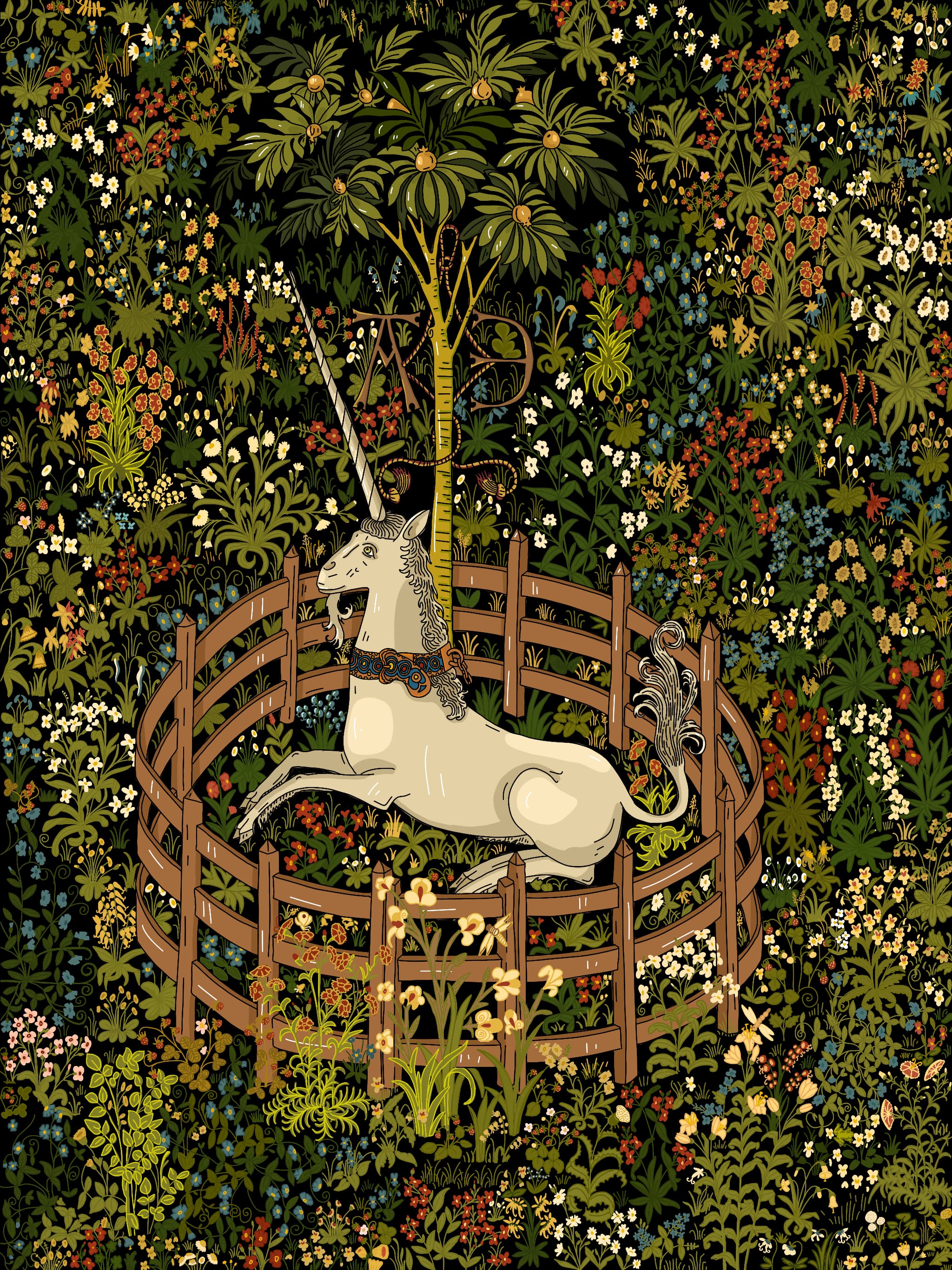
I have now watched the same eleven seconds of a Harry Potter film more times than I can defend in public. It's near the end of Half-Blood Prince. Ginny takes Harry up to the seventh floor to hide the Prince's book — the one that spent the whole year whispering clever, ugly things at him, the one that handed him the curse he opened Draco Malfoy's chest with two scenes earlier. She tells him to close his eyes. She hides it somewhere in that impossible room. She kisses him.
And on the wall behind them, drawing no attention to itself whatsoever, hangs a unicorn.
It isn't set dressing pulled at random from a props warehouse. That's The Unicorn Rests in a Garden, the last of the seven Unicorn Tapestries, woven around 1500 and living since 1938 at the Met Cloisters in upper Manhattan. A unicorn lies inside a circular wooden fence you could step over without spilling your drink, tethered to a pomegranate tree by a chain a determined goat would snap in a second. He isn't pulling. He isn't sulking. He looks like someone who has finally got the seat by the window.
That was the entire point, for the people who first looked at him. The unicorn was the animal no huntsman could take by force — you could ruin your dogs and your spears on him and go home with nothing. What he could be taken by was a girl sitting quietly in a wood. So the low fence and the slack chain aren't a failure of security. They're the argument. He stays because he's decided to. Medieval viewers read the enclosure as marriage, as courtly love, as the wild thing that consents to be held; and once you know that, the scene at Hogwarts stops being a teenage kiss and starts being a thesis statement. The boy who has been feral all film, carrying a dead man's handwriting around in his pocket, is sat down inside a low fence by the girl who took his dangerous book away. Whether the art department was making a joke for the eleven people who'd catch it, or just needed something medieval-looking for the corridor, the wall is doing the reading for us.
Which is a long way of saying we fell down a hole while making this issue, and we'd like to take you down there with us. We went looking for something medieval to put on a cover and came back up holding a working theory about what a book is, which was not the plan, but we've learned to take these things where we find them.
Because there are six more of them, and they are not gentle. The series runs like a film. In the first, hunters walk into the woods, and one of them, up in the corner, signals that he's seen something. In the second, the unicorn kneels at a fountain and dips his horn into a stream a snake has poisoned, so that the other animals can drink — a whole menagerie waits at the water's edge while the hunting party stands and watches, because it would have been unsporting to attack a creature mid-miracle. In the third the chase is on and he clears the stream anyway. In the fourth he fights: kicks a huntsman, goes through a hound with his horn, and generally makes the point that this was never going to be easy. The fifth is where it breaks your heart, because the fifth barely exists. Two fragments survive. You can see a woman's sleeve at the unicorn's throat and his face turned up toward someone who isn't there anymore. The rest was cut up, or worn away, or used for something. In the sixth he's killed in the top left corner and carried back to the castle slung over a horse, and the people at the gate look at him the way people look at a delivery.
And then, in the seventh, he's alive, in a garden, in the sun, tied to nothing that could hold him.
There are red marks on his flank, and for about four seconds you read them as blood. Then you look up and see that the pomegranates over his head have split open and are dripping. No wounds anywhere on him. Just fruit. Pomegranates meant fertility and abundance and, to a medieval eye, resurrection — the thing that comes back with its seeds intact. The old readings of this panel are love and Easter, and honestly, either will do.
We should tell you what these objects actually are, because the numbers are a little unhinged. Wool, silk, silver thread, gilt thread. A hundred and one species of plant grow in the backgrounds, of which more than eighty-five percent have been identified by name; some of them are currently growing in the gardens at the Cloisters, which is the kind of detail that makes a person want to lie down. Every panel carries a cipher — the letters A and E, knotted together, tucked into corners and hung on dog collars — and in five hundred years nobody has convincingly worked out whose initials those are. Anne of Brittany, some say. Adam and Eve. The first and last letters of a motto nobody wrote down. We put our names in a colophon at the back of every issue like people who want to be found, so there's something quietly enviable about a masterpiece that has kept its byline to itself for five hundred years and shows no sign of cracking.
Their own story is better than most of the ones we publish. They first turn up in writing in 1680, in a Paris house belonging to François VI de La Rochefoucauld — yes, that one, the maxims. By the 1720s they'd been shipped down to the family château at Verteuil, where five hung in a bedroom and two sat in a storeroom, already described as half worn out. During the Revolution they were looted, and then they vanished for sixty years. When the family got them back in the 1850s they came out of a barn, punched full of holes, because someone had been wrapping them around fruit trees to keep the frost off. Six centuries of silk and gilt thread, doing service as a tarpaulin. In 1922 they crossed the Atlantic for an exhibition, John D. Rockefeller Jr. saw them and bought them and hung them in his apartment like a man with a small unicorn problem, and in 1937 he gave them to the Cloisters, where all seven were reunited the following year. They are now, by a comfortable margin, the most valuable thing that was ever in that château.
Here's the part we keep circling back to. Try, for a second, to forget everything you've read. Every book, every film, every recap, every three-hour video essay. Now put yourself in a world where information moves at the speed of a horse. The next good story you hear will arrive when a traveller does, or when a company of players sets up in the square, and after that you might wait a year. And you, in that world, want to tell somebody something.
You will tell it in thread.
Think about what that costs. Not money — time. Someone drew this at full scale first, and someone else spent years at the loom, and the pomegranates over the unicorn's head are made of individual passes of coloured wool. Nobody in that room was producing content. There was no chance of it going anywhere; the odds were that the people who saw it would be the people who paid for it, their children, and whoever came to dinner. So ask yourself the honest question: would you spend four years of your working life making a beautiful thing that means nothing? Of course you wouldn't. That's why every flower in these things is loaded. Not because medieval people were obsessed with symbols, but because when a picture takes that long, meaning is the only thing that makes the arithmetic work.
Our own reading came before we found the Harry Potter thing, and we're keeping it. Every writer is a unicorn hunter. They go off into the woods on our behalf, and it's genuinely bad in there — dogs, mud, months of it, the thing you're chasing kicking you in the chest — and if they're lucky and stubborn they come back with something impossible and still breathing. Then they put a low fence around it and a thin chain on it, which is what a book is, and they leave the gate more or less open, so that we can come and stand very close to a wonder without it running off. The unicorn in the garden isn't suffering. He isn't a trophy. He's present, on purpose, for as long as anyone keeps looking.
We're starting this magazine over at a moment when people keep asking, in a slightly strained voice, whether we're still going to need the ones who go into the woods. It's a fair question and these are strange years to love books in. Every month somebody announces that the novel is finished, or that nobody reads, or that the writing is about to be done by something that has never been kicked in the chest by anything. But we've noticed something, and it's made us calm.
The more synthetic the future looks, the dearer the past gets. Humanity has already accumulated an enormous library of stories written by hand, by people, out of their own lives, and every single one of them is permanently immune to the suspicion that's about to attach itself to everything new. That archive is finished. Nobody can add to it and nobody can fake their way into it. And here's the joke on us: we spent years complaining that we'd never live long enough to read it all, that the books kept coming and coming and we'd never catch up. That complaint has turned into an insurance policy. It's the one shelf that can't run out.
So if the future gets boring, we know where we're going. Back to the poems, back to the letters, back to the tapestries, back to a person telling it out loud to eight people around a fire because that's the only distribution network available. Somebody will always want to make a beautiful thing slowly, for almost nobody, with all the meaning they can fit in it. Somebody will always want to stand in front of it. And whoever goes in after the next one will find out what everybody finds out, which is that the dogs were never going to be enough and the spear was mostly for confidence.